Message from our Project Manager
Mā te wā (See you later)
I have some news to share with you all.
I have resigned from my role as Ark project manager. I will be spending more time on some family matters and hoping to do some part time conservation work, as well as volunteering of course!
It has been a privilege being able to work at the Ark for the last 7 years. I have learnt a lot and will miss many aspects of the job. Working with you, the volunteers, has been a real highlight. I appreciate the opportunity to have gotten to know and learn from so many of you, and I look forward to joining volunteer sessions in future to continue our important work in the beautiful Waitākere forest.
Also of course a big thank you to my colleague Laurence, who from my first day has been knowledgeable, helpful and hard working with a distinctive sense of humour!
Thank you to Annalily too for her enthusiastic collaborative work on the Ark buffer zone and as part of the Waitākere branch committee. Both Laurence and Annalily have been strongly supportive and I thank them for the great team work over the years.
My last day is the 6th of March, and as per Ark tradition we will have a scone party on the 5th of March after the Thursday session.
I’m also giving a talk about the Ark at the Third Thursday Waitākere branch talk this month so might see some of you there.
Others of you I hope to see around in the bush, at events and so on!
Gillian
Update on Kauri Dieback prevention and Ark operations:
The following message was recently posted by the Ark Volunteer Reps:
Dear fellow volunteers
As your elected representatives (both as contact people and on the Ark in the Park management committee), we would like to give you some background on the events of this tumultuous year, especially as they have affected volunteers.
Most importantly you should know that all the major players in the management of the Waitākere Ranges and the response to the kauri dieback crisis are united in supporting the on-going activities of Ark in the Park, and the work it is doing in restoring both the bird life and plant life of the region.
As most of you know, ‘Standard Operating Procedures’ have been developed so that we can continue with our conservation activities while minimising any additional burden on the kauri forest. These procedures have been hammered out at many top-level meetings over this past year between various Council people, kauri dieback advisors and, on behalf of the Ark, our advocates Gillian Wadams and Laurence Bechet.
Through all this time Gillian and Laurence have continued to run the Ark whilst communicating and including these extra protocols for kauri dieback, but the closure of the Ark during a baiting round and the continuing changes working towards a better SOP have impacted on baiting and it is a testament to everyone’s perseverance and belief, that support continues for what remains the largest and most important conservation area in the Waitākere Ranges.
The result of the discussions to date has been changes to the ‘SOP’s that match the growing understanding of the scope of the problem and the best ways to respond.
In addition to the human and pig impact of foot traffic, there is growing recognition that terrain and hydrological influences are significant for the spread of the pathogen. The Ark area is to be split up into zones of operation, based on the particular environmental conditions in that zone. Conservation work within any of these areas will involve the same protocols as were proactively established years ago by the Ark: scrubbing and spraying boots at the beginning and end of bait or trap lines, at the junction of tracks, and at stream crossings. We are not to work off track in more than one zone per day and at boundary junctions on tracks boots and gear must be thoroughly cleaned.
At the conclusion of volunteer activities all gear and footwear is removed, contained and transported back to the Ark volunteer base for final complete cleaning. This ensures Ark ‘border control’ prevents any soil movement away from site.
We all hope that the boosts to funding for dieback research announced recently bear results soon. In the meanwhile, the best chance for continued regeneration of the forest via the tiny kauri seedlings and saplings, as well as the kiekie flowers and parataniwha shoots and all the verdancy of the forest you will see throughout the Ark, is that you will continue to protect them from the rats and possums that love them too.
If you have any questions, don’t forget that you elected us to represent you. Get in touch and we will get you answers.
Karen Colgan karen@colgan.co.nz
Ken Harrop kenneth.harrop@gmail.com
Oliver Glampe oliverglampe@orcon.net.nz
Kōkako kōrero
Kōkako around the North Island have had a low breeding season this year, and we see this reflected here at the Ark. We have had just one successful known nest, and it is not confirmed as yet whether the two chicks actually fledged. However, come census time in August we always discover unbanded sub adults who must have fledged the previous season undetected!
Our nest finding contractors and supporting volunteers will be aiming to find the fledglings from Maurice and his unbanded partner’s nest later this week.
It’s a quiet time of year for our birds with some, including kōkako, starting to moult.
What is moulting?
A feather can be compared to human hair or nails in that they are ‘dead’ and made of the same basic ingredient, the protein keratin.
When they get damaged, feathers can’t heal themselves. Instead they have to be completely re- placed. This replacement of all or some of the feathers is called “moult”.
Moulting occurs in response to a mixture of hormonal changes brought about by seasonal changes.
It takes a lot of energy to build new feathers. As a result, timing is important and birds typically time their moults to avoid other periods of high energy demands, such as nesting or migration.
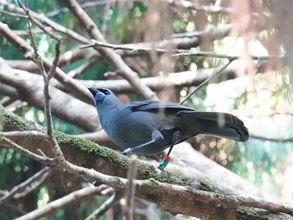
Maurice surveys his territory, warding off troublesome tui. Photo Jacqui Geux
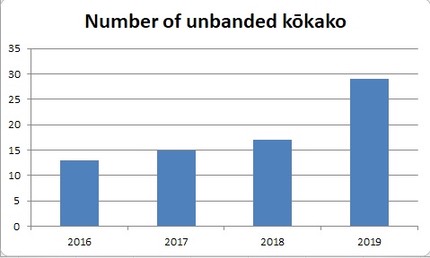
The growth in our population of unbanded kōkako (those who have hatched at the Ark) shows just how much undetected nesting occurs each season, in particular there has been a significant jump in the number of unbanded birds from the 2018 to 2019 census.
The nest finding and watching team are experimenting with a range of different lures in the ring of steel rat traps. These have included Nutella and fruit lollies. Still on the list to try are fish sauce and ‘Smooth’, a non toxic cinnamon flavoured lure.
Also, Jacqui has made another great video of the kōkako pair Francis & Zelah feeding and preening, which you can find on YouTube here: https://www.youtube.com/watch?v=yKqROR78-ok
Right now in the Ark...
Rodent baiting:
Summer baiting is now well underway. The rat monitoring done at the beginning of the baiting round a couple of weeks ago in the P block showed high rat numbers: 70%!
In addition, the current bait uptake observed in P block is high, which means that there are still many rats in this block. This confirms the need to double bag the stations and also that it has been timely to do this baiting rather than waiting after the wasp season.
Based on success in the IW block, the Double Tap formulation and the non toxic lure is likely to be attractive to the rats!
Double Tap has a mild vanilla scent which may attract rats as it’s a change from the cinnamon scent of Brodifacoum.
Wasps
Numbers are still low, but starting to build up. Be cautious!
Robin Monitoring:
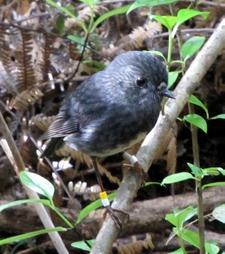
Every year since the first release of 53 robins in 2005 Ark volunteers (with overseas students a key element) have sought out nest sites and monitored the breeding success of the pairs - typically three clutches of 2-3 chicks per season. In the 2010 breeding season we located the nests of 11 pairs (and of course there will be a lot more we didn't discover), and new nesting territories, thanks to the efforts of volunteers who have spread out and found where the birds have settled. Anyone who is interested in helping should contact our Volunteer Coordinator. Volunteers need to have time available Monday to Friday, and to be fit enough to move off-track through our steep and slippery bush.
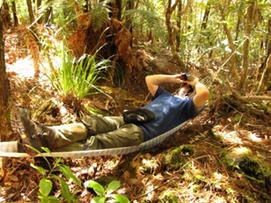
These birds are some of the most charming to be found in the New Zealand bush, with their quiet inquisitive nature making them easy to study and enjoy. Above is a picture taken recently by one of our star robin-finders, Grant Capill, who is shown to the right, hard at work or, just possibly, asleep.
Heidrun and Keryn have been doing a magnificent job on the Auckland City walk finding and protecting robin nests from stoats with John Stewart helping to band fledglings. On one day Heidrun saw 15 birds and one chick!
Meanwhile, the Trappers continue to tramp around their circuits. After rat catch records in October and November (respectively 89 and 95), the numbers have started to decrease with 75 rats in December and 55 inJanuary. Conversely, the number of stoats and weasels reached a peak in December before dropping in January (November: 3, December: 42, January: 12). This is an expected pattern as the peak time for stoats is usually December / January. Also a small increase has been observed in possum catches which went from 2 in December to 8 in January.
Then there's the teams attacking weeds, navigators extending lines to fill in gaps..